Waterdrop G3P600 review: is it the right RO for you?
Updated: Jul 20
If you're looking for a Waterdrop G3P600 review, chances are you're trying to work out whether this popular under-sink reverse osmosis system is really worth £400-£550.
On paper, it has a lot going for it: a compact tankless design, smart monitoring features and much more thorough filtration than a standard water filter.

So there’s little doubt that the G3P600 can produce exceptionally clean drinking water. The real question is whether you need that level of filtration — and whether it’s worth the price for your household.
For some households, it can be a major upgrade, removing limescale-causing minerals while reducing fluoride, PFAS, microplastics and other dissolved contaminants. For others, a cheaper Waterdrop model, an inline filter or a countertop RO system may be more than enough.
In this review, we'll look at what the G3P600 does well, where it falls short, what UK customers think of it and how it compares with the popular alternatives.
Quick verdict
If you're looking for exceptionally clean drinking water, the Waterdrop G3P600 is one of the strongest options we've found. It reduces limescale-causing minerals, fluoride, PFAS, microplastics and other dissolved contaminants, while being far easier to live with than many older RO systems.
It's also highly rated by owners, with 89% of the UK Amazon reviews we analysed awarding it 4 or 5 stars.
The upfront cost won't suit every budget, but for households serious about drinking water quality, the G3P600 hits the sweet spot between performance, convenience and price.
What is the Waterdrop G3P600?
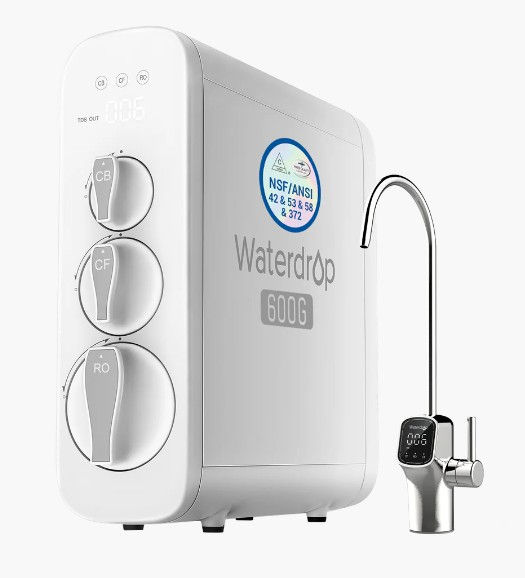
The Waterdrop G3P600 is a tankless under-sink reverse osmosis system designed to produce highly filtered drinking water through a dedicated kitchen tap.
Unlike standard carbon filters, reverse osmosis pushes water through a semi-permeable membrane that removes a very high percentage of dissolved contaminants.
This includes:
Calcium and magnesium (the minerals responsible for limescale)
Fluoride
PFAS ("forever chemicals")
Nitrates
Heavy metals
Microplastics
Chlorine and taste-affecting compounds
The G3P600 combines this filtration with a compact tankless design, a smart tap display and a relatively efficient 2:1 pure-to-drain ratio.
In simple terms, it's designed for people who want much more thorough filtration than a standard water filter can provide.
What UK customers say
We analysed UK Amazon reviews for the Waterdrop G3P600.
Overall sentiment was very positive, with 89% of reviewers giving the system 4 or 5 stars.
The most common positive themes were improved water taste, straightforward installation, compact size and excellent customer support.
Many reviewers commented on how much less space the G3P600 takes up compared to traditional tank-based reverse osmosis systems, while others appreciated features such as the smart TDS display and filter-life monitoring.
Negative feedback was relatively limited. The most common complaints related to installation issues, leaks or faulty components arriving out of the box.
However, what stood out was how often customers praised Waterdrop's customer service when problems did occur, with many describing quick responses and replacement parts being supplied without hassle.

Overall, the reviews suggest the G3P600 delivers what most buyers are looking for: cleaner-tasting water, a compact design and a more modern reverse osmosis experience than traditional systems.
Is Waterdrop a good brand?
Based on our analysis of 100 Waterdrop Trustpilot reviews, the answer is largely yes. 94% of customers rated the brand four or five stars, which is a strong sign of overall trust and satisfaction.
Customers frequently praised the taste and quality of the filtered water, but the standout theme was Waterdrop’s customer service. Reviewers regularly mentioned quick replies, helpful troubleshooting and replacement parts or complete units being sent when something went wrong.
There were some reports of faulty units, leaks, delivery problems and slower resolutions, but these made up a small minority of the reviews. Importantly, many customers who experienced an initial problem still left a positive rating because Waterdrop resolved it well.
Overall, our findings suggest Waterdrop is a well-reviewed brand that generally backs its products and looks after customers when problems arise.
You can read our full Waterdrop reviews analysis for the complete breakdown.
What is the G3P600 actually like to live with?
This is where modern RO systems really differ from older designs.
Day to day, using the G3P600 feels much more like using a normal kitchen tap than a specialist filtration system.
There's no water jug to refill.
There's no countertop machine taking up valuable worktop space.
There's no waiting for a tank to refill.
Instead, filtered water is available whenever you need it from a dedicated tap.
For most households, that convenience is one of the biggest reasons people stick with these systems long term.
What's to like about the Waterdrop G3P600?
1. It removes the minerals responsible for limescale
For hard water homes, this is one of the biggest advantages.
Because reverse osmosis removes calcium and magnesium, water coming from the RO tap won't form limescale.

If you fill your kettle exclusively from the G3P600 tap, you should see little to no scale build-up over time.
That's something most jug filters, on-tap filters and inline filters simply can't achieve.
2. It takes up surprisingly little space
Traditional reverse osmosis systems often require a large storage tank under the sink.
The G3P600 uses a tankless design instead, which means it occupies much less cupboard space and looks considerably tidier.
3. The smart tap is genuinely useful
Some "smart" features feel gimmicky. The G3P600's tap display is one of the exceptions.
It shows:
Filter life
Water quality (TDS)
System status
This makes it easier to keep on top of maintenance and gives users confidence that they're getting the quality water they paid for.
4. Filter changes are simple
One of the frustrations with older RO systems is maintenance.
The G3P600's cartridges twist in and out in seconds without specialist tools.
Reverse osmosis systems only perform well when they're maintained properly, and Waterdrop has done a good job of making filter changes quick and straightforward.
What to consider before you buy
1. The upfront cost
At around £400-£550, the G3P600 costs considerably more than a standard under-sink filter.
The brand says you can install yourself in as little as thirty minutes, but you may need to budget for professional installation if DIY isn't your thing. The system needs connecting to your cold water supply and waste, and you'll also need a hole drilled in your worktop for the dedicated RO tap.
If there's no power socket nearby, you may also need an electrician to add one.
2. You'll need a separate tap
The G3P600 comes with its own dedicated drinking water tap.
For many people that's a benefit, as it clearly separates filtered drinking water from standard tap water.
However, it does mean drilling a hole in your worktop or sink area. This is usually straightforward with laminate worktops or stainless steel sinks, but stone surfaces such as quartz, granite and marble typically require specialist tools and a little more care.
3. Wastewater
Like all reverse osmosis systems, the G3P600 produces some wastewater during the filtration process.
Its 2:1 pure-to-drain ratio means that for every two litres of filtered water it produces, around one litre is sent to drain. That's considerably more efficient than many older tank-based RO systems, which can waste several litres of water for every litre filtered.
That said, it's not the most efficient option available. Newer models such as the Waterdrop G3P800 improve this to a 3:1 ratio, while conventional inline filters like the Maverick Mav 02 produce no wastewater (more on those options later).
4. Ongoing filter costs
The G3P600 uses three filters:
RO membrane – replaced every 2 years (around £110)
CF filter – replaced every 6 months (around £31 each)
CB filter – replaced every year (around £31)
Based on current replacement prices, the ongoing filter cost works out at roughly £148 per year.
Is there a better option for your budget?
The G3P600 might be the perfect choice for your home — or it could be overkill.
Here's how it stacks up against alternatives products, from budget-friendly inline filters to premium reverse osmosis systems and water softeners.
*Prices change regularly, so use these as a guide and see brand websites for current prices.
How does the G3P600 compare to other products?
Waterdrop G3P600 vs Maverick Mav 02
The Maverick Mav 02 is an inline filter that's significantly cheaper and easier to install. It's designed to improve drinking water quality and help slow limescale build-up (the brand claims by up to 99%).

The G3P600 goes much further.
It removes hardness minerals entirely from drinking water and provides substantially more comprehensive filtration, including fluoride, PFAS, nitrates and many dissolved contaminants.
If your budget allows and your goal is maximum drinking water quality, the G3P600 is the stronger solution.
If you simply want better tasting water and a lower upfront cost, the Maverick may be enough.
Find out more about the Marverick Mav 02 inline filter
Waterdrop G3P600 vs Waterdrop G2P600
If your main goal is reverse osmosis filtration at a lower cost, the G2P600 could be the better no frills option at around £250-£300.
Both systems use reverse osmosis technology and both produce very high-quality drinking water.
The G3P600 adds a smart tap display, TDS monitoring, holiday mode, an additional filtration stage and more independent certifications.

For most people, the decision comes down to whether those extra features justify the higher price.
If you're budget-conscious and simply want excellent RO filtration, the G2P600 is probably enough. If you like the idea of seeing filter life and water quality at a glance, the G3P600 feels like the more polished product.
Waterdrop G3P600 vs Waterdrop G3P800
Waterdrop's G3P800 is the more advanced model, with a higher price tag.
The biggest difference isn't actually the flow rate. While the G3P800 produces up to 800 gallons per day compared with 600 gallons per day for the G3P600, most UK households are unlikely to notice much difference in day-to-day use.
More important is the efficiency. The G3P600 uses a 2:1 pure-to-drain ratio, while the G3P800 improves this to 3:1. In simple terms, the G3P800 wastes less water while producing the same amount of filtered water.
The G3P800 also adds a built-in UV sterilising light. Reverse osmosis already removes the vast majority of contaminants, but the UV stage provides an additional layer of protection against bacteria and microorganisms after filtration.
If you're environmentally conscious, have young children, live with elderly relatives, have someone with a weakened immune system in the household, or use a private well or other non-mains water supply, the G3P800's added water efficiency and built-in UV stage may be enough to justify the extra cost over the G3P600.
For most households, however, we think the G3P600 remains the sweet spot in the range. The filtration performance is already excellent, and the lower purchase price will be the deciding factor for many buyers.
Read more about the G3P800 in our review ↗
Waterdrop G3P600 vs countertop RO systems
Not everyone needs to install an under-sink system to benefit from RO water.
If you rent, don't want to drill through your worktop, or simply prefer something portable, a countertop reverse osmosis system such as the Waterdrop A2 may be a better fit.
The A2 simply plugs in and sits on your worktop. It also offers instant hot water, which can be a huge advantage if you drink a lot of tea, coffee or instant drinks.
The trade-off is convenience. You'll need to refill the water tank regularly, it takes up worktop space, and it doesn't feel as seamless as having filtered water available directly from a dedicated tap.
If you're staying in your home long term, we'd generally lean towards the G3P600. If flexibility is more important, the A2 is worth considering.
Read our Waterdrop A2 review ↗
Waterdrop G3P600 vs a water softener
These products solve completely different problems.
A water softener protects your entire home from hard water by removing the minerals that cause limescale before they enter your plumbing system.
The G3P600 only treats drinking water at a single tap, and removes things like fluoride, PFAS, microplastics and the small amount of sodium added during softening.
That's why many hard water households choose both. The water softener protects the boiler, shower, taps and appliances, while the reverse osmosis system provides highly filtered drinking water.
For many homes, it's the closest thing to a "best of both worlds" setup.
To find out more, check out our guide to water softeners and whether they're worth it
Is the G3P600 right for you?
The Waterdrop G3P600 won't be the right choice for everyone.
If you're simply looking for slightly better tasting water, there are cheaper options available.
However, if you want one of the most thorough drinking water filtration systems available, the G3P600 is easy to recommend. It removes the minerals responsible for kettle limescale, produces exceptionally clean drinking water, takes up very little cupboard space and is far easier to live with than many traditional reverse osmosis systems.
It's also backed by strong customer feedback. In our analysis of Waterdrop reviews, customers consistently praised the taste of the water, compact design and ease of installation, giving us confidence that it's a safe brand to buy from.
For most UK households considering reverse osmosis, the G3P600 strikes a great balance between performance, convenience and price within the current Waterdrop range.
Waterdrop G3P600 reverse osmosis system FAQs
Is the Waterdrop G3P600 worth it?
If your goal is exceptionally clean drinking water and reducing limescale in kettles and coffee machines, yes. It's one of the most user-friendly, well designed reverse osmosis systems currently available in the UK.
Does the Waterdrop G3P600 remove limescale?
It removes the calcium and magnesium responsible for limescale from the water passing through the RO tap. That means kettles filled from the system should see little to no scale build-up.
Does the Waterdrop G3P600 remove fluoride?
Yes. Reverse osmosis is one of the most effective forms of domestic filtration for reducing fluoride.
Is the Waterdrop G3P600 better than a water softener?
Not necessarily. They solve different problems. The G3P600 improves drinking water quality at one tap, while a water softener protects your entire home from hard water.
Is the Waterdrop G3P800 worth the extra money?
For many households, the G3P600 will be the sweet spot in the range, offering an excellent balance of performance, features and price.
That said, the G3P800 does offer a few meaningful upgrades. It has a more efficient 3:1 pure-to-drain ratio, meaning it wastes less water, and it also includes a UV sterilisation stage for additional protection against bacteria and other microorganisms.
If those features matter to you — or you simply want Waterdrop's most advanced tankless system — the G3P800 could be worth the extra investment.
* All prices and specifications correct at time of publishing.

Author bio: Lucinda Smalley is the founder of Hard Water Home, a UK-based consumer site helping households in hard water areas understand the challenges and solutions more easily — and make smarter choices for their health and homes. Based in Poole, she also co-runs an award-winning plumbing company, giving her first-hand insight into how water quality affects everything from appliances to skin and hair. When she’s not writing, she’s happiest at the beach with her family and a good cup of coffee (minus the floaty bits!). More about us ➡


