Best reverse osmosis water filter UK: which system is right for your home?
Updated: Aug 12
If you’ve started looking for the best reverse osmosis water filter UK, you’ve probably already noticed how quickly it gets confusing.
There are under-sink systems, countertop systems, tanked systems, tankless systems, remineralised systems, instant hot water dispensers… and they all claim to give you the cleanest water, but which is right for you?

Reverse osmosis (RO) is one of the most effective ways to filter drinking water at home, especially if you live in a hard water area. A good RO system can reduce a wide range of dissolved substances and contaminants, including limescale minerals, chlorine, fluoride, heavy metals and microplastics. That means cleaner-tasting water, far less scale in your kettle, and no more skummy layer on your tea.
This guide compares six of the best reverse osmosis water filter systems available in the UK: three under-sink RO systems and three countertop RO systems. We’ll walk through the benefits and drawbacks of each, so you can decide which type of reverse osmosis system — and which model — is best for your home.
Under-sink vs countertop reverse osmosis: which is right for you?
Most people looking at reverse osmosis fall into one of two camps.
You either want a system installed under your sink, or you want something simple that sits on the worktop and doesn’t need plumbing.
Both can work well. The right choice depends on your home.
Under-sink reverse osmosis systems
If you’re planning to stay in your home and want a long-term solution, under-sink systems are usually the best route.
They’re hidden away, give you a dedicated drinking water tap, and once they’re in, they just become part of the kitchen.
Best if you want:
no worktop clutter
no daily maintenance
a set-and-forget drinking water upgrade
Considerations:
you’ll need space in the cupboard under your sink
you may need professional installation if you’re not confident with DIY
it needs to be practical to drill through your worktop or sink area for a dedicated tap
if you go for a tankless design you'll need a plug socket for power
traditional tanked designs produce high levels of wastewater
Countertop reverse osmosis systems
Countertop reverse osmosis systems are for people who want the benefits of RO without the plumbing work.
They sit on your worktop, you plug them in at a socket for power, and you manually fill a tank with tap water.
Best if you want:
no drilling
no dedicated tap
no under-sink installation
a plug-in RO system you can set up more easily
Considerations:
they’re visible on the worktop
they take up counter space
you’ll usually need to refill the water tank manually
RO and hard water
If you live in a hard water area, reverse osmosis can make a noticeable difference.
Hard water contains calcium and magnesium — the minerals that cause limescale in kettles, around taps and sometimes as flakes in hot drinks.
Most standard filters can improve taste, but they don’t properly remove hardness minerals. Reverse osmosis does, which is why it can stop kettle limescale at source.
Just remember: a standard RO system only treats your drinking water. It won’t protect your whole home like a water softener, but for tea, coffee, kettles and drinking water, it’s one of the most effective options.
Best under-sink reverse osmosis systems UK
Best overall: Waterdrop G3P600
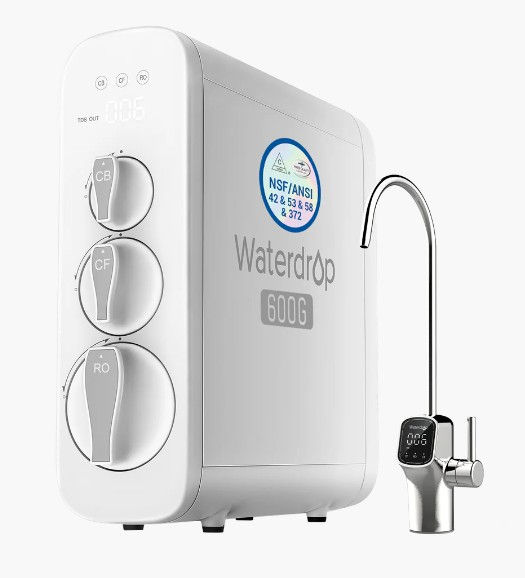
The Waterdrop G3P600 is our best overall reverse osmosis system for most UK homes.
It’s a tankless under-sink RO system, which means it doesn’t rely on a bulky storage tank under your sink. Instead, it filters water on demand and sends it to a dedicated drinking tap.
That makes it a much better fit for modern UK kitchens, where the cupboard under the sink is usually already fighting for space with cleaning products, bins, pipework and the odd carrier bag collection we all still haven’t taken to the supermarket.
The G3P600 has a strong flow rate for everyday use, a compact design, and a smart tap that shows the TDS reading (how clean your water is) and lets you know when the filters need changing.
It’s also worth looking at wastewater. All reverse osmosis systems produce some wastewater as part of the filtration process, but this model has a 2:1 pure-to-drain ratio.
In plain English, that means it produces two cups of purified water for every one cup of wastewater, which is much more efficient than traditional RO systems.
The G3P600 strikes a really good balance between design, performance and price. You’ll just need to factor in installation if you’re not confident fitting it yourself.
Best for
People who want a sleek, low-maintenance reverse osmosis system that fits neatly into a modern kitchen.
Not ideal for
People who don’t want installation work or cupboards where a power outlet isn't possible.
A note on Waterdrop
We’ve installed Waterdrop systems through our plumbing company, and they stand out for their modern design, build quality and easy maintenance.
Waterdrop also has a strong customer reputation, with around 94% of Trustpilot reviewers rating the company 4–5 stars. Read more about Waterdrop filter reviews.
Best traditional tanked system: iSpring RCC7AK

If you want a more traditional reverse osmosis system, the iSpring RCC7AK is a solid option and one of highest rated RO systems available on Amazon.
This is a tanked under-sink RO system, which means filtered water is stored in a tank rather than filtered on demand and it doesn't need to be plugged in for power. That makes it a more classic setup, and it can be a good choice if you’re comfortable with a slightly bulkier installation.
Traditional tanked RO systems can also be less efficient with water. According to iSpring, this system produces around three cups of wastewater for every one cup of filtered drinking water, although the exact amount can vary depending on water pressure, temperature and your incoming water quality. That’s a lot more wastewater than the G3P600, which produces two cups of filtered water for every one cup of wastewater.
But the iSpring does have a useful feature: remineralisation.
Reverse osmosis removes minerals from water. That’s great for limescale, but some people find plain RO water tastes a bit too flat. The iSpring RCC7AK includes an alkaline remineralisation stage, which adds some minerals back in after filtration to improve taste.
That makes it a good middle-ground option if you want proper reverse osmosis filtration, but don’t love the idea of completely demineralised drinking water.
Best for
People who want a traditional under-sink RO system with remineralisation and don’t mind having a storage tank.
Not ideal for
Small under-sink cupboards, anyone who wants the neatest possible install, or households on a water meter who are concerned about wastewater.
Best high-spec system: Waterdrop X12

The Waterdrop X12 is the high-spec option in this guide.
It’s a tankless under-sink reverse osmosis system, but it goes beyond the basics with a higher output, smart tap, 11-stage filtration and remineralisation.
That makes it a good fit if you want the benefits of RO — including very low limescale in your drinking water — but you also want the finished water to feel a bit more rounded in taste.
This matters because reverse osmosis is almost too effective. It removes the minerals that cause limescale, but it also removes minerals some people like in drinking water (Evian is full of hard water minerals!). A remineralised RO system is designed to give you the purity benefits first, then add some minerals back in afterwards.
The X12 is not the budget choice. It’s the option for people who already know they want reverse osmosis and want a premium system from the start.
Best for
People who want a high-spec under-sink reverse osmosis system with remineralised water, strong flow and a more premium feel.
Not ideal for
Anyone trying to keep the upfront cost down.
Best countertop reverse osmosis systems UK
Best cold countertop system: AquaTru Classic

If you want a cold countertop reverse osmosis system without hot water, AquaTru Classic is the one to look at.
It’s a plug-and-play countertop RO system, so there’s no plumbing or permanent installation.
You fill the tank, let the machine filter the water, and use the filtered water for drinking and putting in your kettle for tea, coffee or cooking.
The main thing to understand is that countertop systems are more hands-on. Unlike an under-sink RO tap, you’ll need to refill the tank and keep the unit on your worktop.
But if you want proper reverse osmosis without touching the plumbing, AquaTru is a strong place to start.
Best for
People who want the benefits of reverse osmosis without installation, plumbing work or a dedicated tap.
Not ideal for
Small kitchens with limited worktop space, or anyone who would benefit from instant hot and cold filtered water.
Best hot and cold countertop system: Waterdrop A2
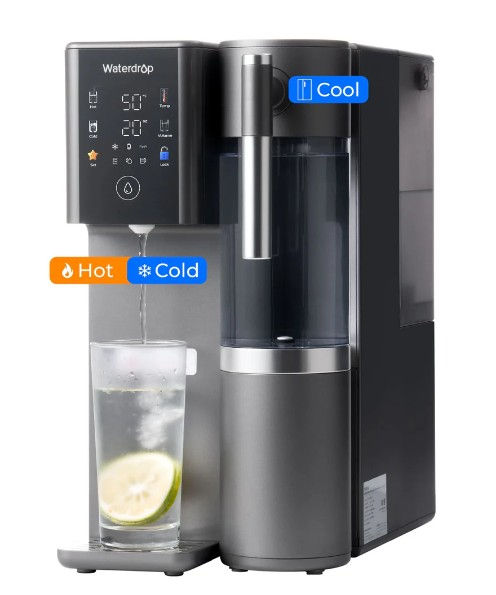
The Waterdrop A2 is a more advanced countertop option because it gives you both hot and cold reverse osmosis filtered water.
That makes it more useful day to day.
Instead of filtering cold water and then boiling the kettle, you can get filtered hot water directly from the unit. If you drink a lot of tea, coffee or herbal drinks, that convenience feels like a big added bonus.
It’s still a countertop system, so it needs visible space. But it can replace your kettle, which helps balance out the worktop space issue.
For hard water homes, the appeal is clear. You’re getting instant RO filtered water for hot drinks, which means less limescale and no more skummy film on your tea.
Best for
People who drink hot drinks and want instant hot water and cold water in one machine, with no waiting for the kettle to boil.
Not ideal for
Minimal kitchens, very small worktops, or anyone who only wants a simple cold water filter.
Best personalised remineralised water: Sküma
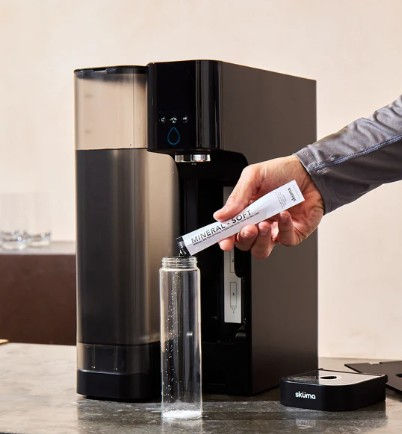
Sküma takes a slightly different approach to reverse osmosis.
Like other RO systems, it filters the water first. But then it lets you add minerals back in using different mineral profiles.
That makes it less of a basic water filter and more of a personalised water system.
If you care about taste, hydration routines, minerals, and the experience of drinking water, it’s one of the more interesting countertop systems.
The idea is simple: purify first, then rebuild the water to suit what you want from it.
Best for
People who want a premium countertop RO system with personalised remineralisation.
Not ideal for
Anyone who wants instant hot and cold water or has limited workspace.
Skuma right for you? Read our detailed Skuma water review and get £20 off with our Skuma discount code↗
How reverse osmosis compares to other options
Before you choose a system, it helps to understand where reverse osmosis sits compared with other water filters and water softeners.
Reverse osmosis vs a normal water filter
A standard water filter and a reverse osmosis system are not doing the same job.
Most jug filters, tap filters and under-sink inline filters are mainly designed to improve taste, reduce chlorine and deal with certain contaminants. Some may help reduce scale formation, but they don’t properly remove the minerals that cause hard water.
Reverse osmosis goes further. It removes dissolved minerals including calcium and magnesium, which is why it’s a much stronger option if your main problem is kettle limescale, flakes in tea, or very hard drinking water.
A normal filter is simpler and cheaper. RO is more complete.
Find out more about the different types of water filters.
And if you like the idea of filtered hot and cold water but don’t necessarily want reverse osmosis, Our Taap is another option worth considering. It connects to the mains and keeps the natural minerals in the water while helping to control limescale.
Reverse osmosis vs a water softener
Reverse osmosis treats drinking water at one point, usually your kitchen tap. It’s brilliant for tea, coffee, kettles and drinking water.
A water softener treats the water entering your whole home. That means it helps with showers, taps, toilets, washing machines, dishwashers, pipework and heating systems.
So if you only care about drinking water and kettle limescale, RO may be enough. If you want to protect the whole house from hard water, a proper salt-based water softener is the more complete solution.
Some homes use both: a water softener for the whole house, then reverse osmosis at the kitchen tap for drinking water.
Before you buy
Before choosing a reverse osmosis system, check the practical details: whether you want under-sink or countertop, how much space you have, whether you’ll need installation, how often the filters need replacing, and whether you want remineralised water.
Wastewater is worth checking too. Reverse osmosis is very effective, but it does produce some wastewater as part of the process. Newer tankless systems are usually more efficient than older traditional systems, but it’s still something to consider — especially if you’re on a water meter.
Is a reverse osmosis water filter worth it?
A reverse osmosis water filter is worth it if you want the cleanest possible drinking water and you’re fed up with limescale in your kettle.
It’s especially useful if you live in a hard water area and drink a lot of tea or coffee.
It may also be worth it if you currently buy bottled water and want a lower-waste, at-home alternative.
But it’s not the right choice for everyone.
If you just want slightly better-tasting water, a simpler filter may be enough. If your main issue is limescale across the whole bathroom and kitchen, a water softener may be a better long-term fix.
RO is best when your priority is drinking water quality.
Final verdict: which reverse osmosis system should you buy?
Choose Waterdrop G3P600 if you want the best all-round reverse osmosis system for most UK homes. It’s compact, tankless and suited to modern kitchens.
Choose iSpring RCC7AK if you want a more traditional tanked setup and don’t mind the extra cupboard space or wastewater.
Choose Waterdrop X12 if you want a high-spec under-sink system with remineralisation and a more premium setup.
Choose AquaTru Classic if you want cold RO filtered water without plumbing work or a dedicated tap.
Choose Waterdrop A2 if you want countertop RO with instant hot and cold filtered water.
Choose Sküma if you want a more personalised mineral setup after filtration.
For hard water homes, the biggest benefit is simple: reverse osmosis removes the minerals that cause limescale in drinking water. So if you want clearer tea, cleaner-tasting water and a kettle that doesn’t constantly need descaling, RO is one of the most effective upgrades you can make.
FAQs
What is the best reverse osmosis water filter UK?
For most UK homes, the Waterdrop G3P600 is the best overall reverse osmosis water filter. It’s tankless, compact and suited to modern under-sink installation. If you want countertop RO instead, AquaTru is a strong cold-water option, while Waterdrop A2 is better if you want hot and cold filtered water.
Does reverse osmosis remove limescale?
Yes. Reverse osmosis removes the dissolved minerals that cause limescale, including calcium and magnesium. That’s why RO water is especially useful for kettles, coffee machines and hot drinks in hard water areas.
Is reverse osmosis good for hard water?
Reverse osmosis is very good for hard water drinking water. It removes the minerals that cause limescale from the water you drink and boil. However, a standard RO system only treats one tap, so it won’t protect your whole home like a water softener would.
Is RO water safe to drink?
RO water is generally safe to drink when the system is properly installed and maintained. Some people prefer remineralised RO water because plain RO water can taste flatter after the minerals have been removed.
Do I need remineralisation?
Not always. If your main goal is stopping limescale, standard RO water is fine. If you care more about taste and mineral balance, choose a system with remineralisation.
Is an under-sink or countertop RO system better?
An under-sink RO system is usually better for homeowners who want a long-term, hidden setup. A countertop RO system is better for renters, smaller kitchens, or anyone who doesn’t want plumbing work.
Do reverse osmosis systems waste water?
Yes, reverse osmosis systems produce some wastewater during filtration. Newer systems are usually more efficient than older models, but it’s still something to factor in before buying, especially if you’re on a water meter.
Can reverse osmosis replace a water softener?
Not usually. Reverse osmosis is mainly for drinking water. A water softener treats the whole home, including showers, washing machines, bathrooms and pipework. If you want whole-house limescale protection, a water softener is the stronger option.

Author bio: Lucinda Smalley is the founder of Hard Water Home, a UK-based consumer site helping households in hard water areas understand the challenges and solutions more easily — and make smarter choices for their health and homes. Based in Poole, she also co-runs an award-winning plumbing company, giving her first-hand insight into how water quality affects everything from appliances to skin and hair. When she’s not writing, she’s happiest at the beach with her family and a good cup of coffee (minus the floaty bits!). More about us ➡


