Do water filters remove limescale? And the truth you should know
Updated: Sep 28
Limescale is a nuisance in your kettle, and it’s also responsible for that scummy layer that forms on top of your tea.

So if you’re looking for ways to tackle hard water, you’re probably wondering whether water filters actually remove limescale.
Here’s the honest — and slightly confusing — answer:
Yes and no.
Hear me out.
Some water filters can help with limescale, but only if they’re designed for the job.
Most everyday filters are mainly focused on better-tasting water, chlorine reduction or general filtration. That includes many standard water filter jugs and some popular inline filters, such as Water2.
They won’t necessarily reduce limescale unless they specifically mention hard water, limescale reduction or anti-scale technology.
Jugs, on-tap filters and inline filters designed for hard water usually reduce or slow limescale build-up, rather than fully removing the calcium and magnesium minerals that make your water hard.
If you want to remove the minerals that cause limescale from your drinking water, reverse osmosis is usually the strongest option.
RO systems remove dissolved minerals including calcium and magnesium, which is why they are often the best choice if your main problem is kettle scale, tea scum or very hard drinking water.
The truth about removing limescale: you get what you pay for
With water filters, the more you spend, the more effective the limescale reduction usually gets.
At the lower end, around £10–£50, you’ve got water filter jugs and on-tap filters. These can be a good place to start. They may help reduce kettle scale a little and make your water taste better, but they are not usually powerful enough to fully deal with hard water.
Move up to around £100–£250, and you’re looking at inline filters or 3-way tap systems with anti-scale technology. These sit under the sink, filter your drinking water before it reaches the tap, and are usually more effective than a jug.
Then, if you’re completely fed up with limescale and want the strongest result in your kettle, tea and coffee, you’re looking at reverse osmosis. RO systems are more of an investment, usually around £280–£1,000+, but they remove the calcium and magnesium that cause limescale.
Jump to:
Lower effect: water filter jugs and on-tap filters
Best for: better-tasting water, light kettle scale reduction and a low-cost first step.
Not ideal for: very hard water, heavy limescale, tea scum, or people who want the strongest possible limescale reduction.
Water filter jugs and on-tap filters are usually the easiest and cheapest place to start.
They can be useful if your main problem is better-tasting tap water, less chlorine taste, clearer drinks and slightly less kettle scale.

But not all filters in this category are designed for limescale. Look for jugs, on-tap filters or cartridges that specifically mention hard water and limescale.
These can make a noticeable difference compared with unfiltered tap water. So if your kettle scales up quickly, the right jug or on-tap filter may help slow the build-up.
But they are still a lower-effect option compared with inline anti-scale filters or reverse osmosis.
A jug filter may help reduce kettle scale, but you’ll probably still need to descale your kettle.
On-tap filters are convenient because they give you filtered water straight from the tap, so no more filling and lifting a heavy jug.
These options are a good first step if you want something affordable and simple. They’re less ideal if your water is very hard or you want to stop limescale as much as possible.
Do water filter jugs remove limescale?
Water filter jugs can help reduce limescale, you should look for cartridges designed for hard water.
The BRITA MAXTRA PRO Limescale Expert cartridge is a good example. It is designed for hard water areas and uses ion exchange pearls to reduce limescale-forming minerals, rather than just changing how those minerals behave.
This can help with kettle scale, taste and the appearance of hot drinks.
But a jug filter is unlikely to completely stop limescale, especially if you live in a very hard water area. It reduces some of the hardness minerals, but it does not remove them as completely as reverse osmosis.
The biggest downside is convenience. You have to keep refilling the jug, wait for the water to filter through, and replace the cartridges regularly. For some households, that’s fine. For others, especially families getting through a lot of water, it can become annoying quite quickly.
A jug is a good option if you want to test whether filtered water helps with your kettle before investing in anything more permanent.
Do on-tap filters remove limescale?
On-tap filters attach directly to your existing kitchen tap, so they’re usually more convenient than a jug. You don’t have to keep refilling anything — you just switch between filtered and unfiltered water as needed.
For limescale, the effect depends heavily on the filter.
FlowPure, for example, lists 150+ contaminants and states that it is effective on fluoride and limescale. It can be a practical option if your main priorities are better-tasting water, everyday filtration and a step up from a jug.
If you’re keen to learn more about tap-mounted options, see our guide to the best on-tap water filters in the UK, where we compare filtration performance, running costs and ease of use.
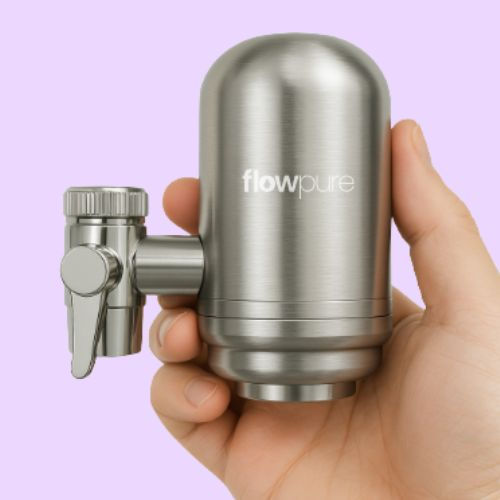
But on-tap filters are still usually a lower-effect option. So if your limescale issue is fairly mild — or you’re happy for scale to be slowed rather than stopped — an on-tap filter can make sense.
If you’re trying to properly tackle kettle scale, tea scum or very hard water, you may need an inline anti-scale filter or reverse osmosis system instead.
Medium effect: inline filters and 3-in-1 taps with anti-scale technology
Best for: households that want a neater, more permanent drinking-water filter with better limescale control than a jug.
Not ideal for: people who want the strongest possible reduction in kettle scale and tea scum.
These options usually work better than jugs or on-tap filters because the cartridges are larger and the water has more contact time with the filter media. That gives the filter more opportunity to reduce or control limescale before the water reaches your glass, kettle or coffee machine.
Inline filters
Inline filters sit under the sink and filter your drinking water before it reaches the tap. They’re usually stronger than a jug or on-tap filter, but simpler than reverse osmosis.
This is where filters like the Maverick Mav 02, with its dedicated anti-scale stage make sense. It works with your existing kitchen tap, filters the cold water only, and is usually a DIY installation.

It’s a good middle-ground option if you want something more permanent than a jug, without a filter sitting on the worktop.
Water2 is another popular inline option, so many people wonder: does Water2 filter limescale? From our research, Water2 focuses more on better-tasting filtered tap water and does not make clear limescale reduction claims. If scale is your main problem, we’d choose one with dedicated anti-scale technology instead.
3-in-1 taps
If you’re also in the market for a new kitchen tap, a 3-in-1 tap, like the Brita mypure P1 is another option to consider. The tap connects to a filter below the sink and usually gives you unfiltered hot, unfiltered cold and filtered cold water from one tap. So you can upgrade your kitchen tap and add filtered drinking water at the same time.

The main benefit of these options is convenience. The filter is hidden away under the sink, you get filtered water straight from the tap, and there’s no jug to keep refilling. Plus filter changes are usually only once a year.
Do inline water filters remove limescale?
Some inline water filters can reduce limescale build-up, but not every inline filter is designed for hard water.
If you want an inline water filter for limescale, look for one with dedicated anti-scale technology. The Maverick Mav 02 is a good example because it includes a specific anti-scale stage designed to reduce limescale in drinking water.
They may not remove hardness minerals in the same way as reverse osmosis, but they can help control how those minerals behave in your water. That means less scale sticking to kettles, taps and hot drink surfaces.
This makes them a useful middle-ground option.
They are usually more effective and convenient than a jug or on-tap filter, but cheaper and simpler than a full RO system.
An inline filter can be a good fit if:
you want filtered water from a proper tap
you don’t want to refill and lift heavy jug
you want to reduce kettle scale
you want lower-maintenance filtration
you do not want a reverse osmosis system
However, they do still have limits. If your water is extremely hard, you may still get some limescale especially towards the end of the filters life. And if your goal is to remove calcium and magnesium as much as possible, reverse osmosis is the stronger choice.
Are 3-way tap filters good for limescale?
A 3-way tap gives you hot, cold and filtered water from one kitchen tap.
The tap itself is connected to a filter cartridge below the sink, so the filtered drinking water comes through the same tap body as your normal hot and cold water.
For limescale, the performance depends on the cartridge or filter system being used.
A BRITA 3-in-1 tap system, for example, is usually connected to a BRITA P 1000 filter cartridge under the sink. This cartridge is designed to reduce limescale, chlorine and other substances that can affect the taste and smell of your water. BRITA also says its P 1000 and P 3000 cartridges use ion exchange resin and have three water hardness settings, which helps adapt the filter to your local water quality.

So, a 3-way tap filter can be a smart middle-ground option if you want everyday filtered water and some limescale reduction built into your kitchen.
It is neater and more permanent than using a jug, but it is still not the same as reverse osmosis. If you live in a very hard water area and want the biggest difference in your kettle, tea and coffee, RO is usually the stronger choice.
Most effective: reverse osmosis filters
Best for: very hard water, kettle scale, tea scum and people who want the strongest drinking-water option for limescale.
Not ideal for: people who only want a cheap, simple filter or don’t want to refill or maintain a countertop system.
Reverse osmosis is usually the most effective type of drinking-water filter for limescale.
That’s because RO doesn’t just improve the taste of water or change how scale behaves. It removes dissolved minerals from the water, including calcium and magnesium — the minerals responsible for limescale.

This is why reverse osmosis water is often much better for kettles, hot drinks and tea scum. If you use RO water in a kettle, you should see far less scale build-up compared with normal hard tap water.
There are two main types of reverse osmosis system: under-sink RO systems and countertop RO systems.
Under-sink systems are fitted below your kitchen sink and usually connect to a separate drinking water tap that needs to be drilled into your worktop or sink area. They are a good option if you want filtered water built into your kitchen.
Countertop RO systems sit on the worktop and don’t usually need plumbing. They can be a better choice if you rent, don’t want installation work, or want the added bonus of filtered hot water on demand too.
Do reverse osmosis filters remove limescale?
Yes — reverse osmosis is one of the best drinking-water filtration methods for removing the minerals that cause limescale.
Hard water contains dissolved calcium and magnesium. When that water is heated, those minerals can form limescale inside kettles, coffee machines and around taps.

Reverse osmosis pushes water through a very fine membrane, which removes many dissolved substances from the water, including hardness minerals.
That makes RO a strong choice if your main hard water problems are:
kettle scale
tea scum
cloudy hot drinks
poor-tasting tea or coffee
very hard drinking water
constantly descaling appliances
Remember though, a drinking-water RO system only treats the water you drink or cook with. It won’t protect your whole house from limescale, for that you’ll need a water softener.
Countertop RO vs under-sink RO for limescale
Both countertop and under-sink reverse osmosis systems can work well for limescale. The main difference is how they fit into your kitchen.
A countertop RO system, like the Waterdrop A2, sits on your worktop and usually does not need plumbing.
The kettle limescale hack nobody talks about
Some countertop RO systems give you hot reverse osmosis water on demand.
That means no filling the kettle, no waiting for it to boil, and no repeatedly heating hard tap water.
In our home, this has virtually eliminated kettle use — saving time on tea and coffee, while also helping us avoid kettle limescale in the first place.
Read our review of the Waterdrop A2 to find out more.
An under-sink RO system, like the Waterdrop G3P600, is fitted below the sink and usually connects to a separate drinking water tap. It is a better fit if you want a more permanent RO set-up built into your kitchen and use a lot of filtered water.
The trade-off is simple: countertop RO is easier to set up but takes up worktop space and needs refilling. Under-sink RO looks neater, but needs installation.
We’re generally fans of Waterdrop for RO systems because they have a good range of quality models and excellent customer feedback. If you want to know more about the brand before buying, we’ve also analysed 100 real Waterdrop reviews.
Which water filter type is best for limescale?
Which water filter should you choose?
The best water filter for limescale depends on how bad your hard water problem is.
If you only want to reduce kettle scale a little, a hard water filter jug can be a good starting point. It is affordable, easy to try and does not require installation.
If you want filtered water on demand and you don’t want to keep refilling a jug, an on-tap filter may be a more convenient option. Just remember that it may be better for taste than serious limescale control.
If you want something more permanent, an inline filter or 3-way tap system with anti-scale properties is a better middle ground. This can be a good choice if you want your filtered water built into your kitchen and you want stronger limescale reduction than a jug.
But if your main goal is to remove the minerals that cause limescale from your drinking water, reverse osmosis is the strongest option.
For very hard water, tea scum and the cleanest result in hot drinks, RO is usually the most effective choice.
FAQs
Do water filters stop limescale completely?
Most water filters do not stop limescale completely. Jugs, on-tap filters and inline anti-scale filters may reduce or slow limescale build-up, but reverse osmosis is usually the strongest option for removing the calcium and magnesium minerals that cause limescale.
Do water filters remove calcium from water?
Some do. Reverse osmosis systems remove calcium and magnesium from drinking water. Some jug filters can reduce hardness minerals, but usually not as completely as RO. Other filters may focus more on changing how minerals behave, rather than removing them.
Will a water filter stop my kettle getting limescale?
It depends on the filter. A hard water jug filter may slow kettle scale, an inline anti-scale filter may reduce it more, and reverse osmosis water should make the biggest difference because it removes the minerals that form limescale when heated.
What is the best water filter for hard water?
For light hard water problems, a jug or on-tap filter can be enough. For better limescale control, look at an inline anti-scale filter or 3-way tap system. For very hard water, kettle scale and tea scum, reverse osmosis is usually the best drinking-water filter option.
Do water filters help with tea scum?
Some can. Tea scum is linked to hard water minerals, so filters that reduce or remove those minerals can help. A jug filter may improve it, but reverse osmosis usually gives the biggest difference.
Is filtered water the same as softened water?
No. A drinking-water filter usually treats water at one tap and may reduce certain contaminants, tastes, smells or minerals. A water softener is a whole-house system designed to tackle hard water before it travels around your home.

Author bio: Lucinda Smalley is the founder of Hard Water Home, a UK-based consumer site helping households in hard water areas understand the challenges and solutions more easily — and make smarter choices for their health and homes. Based in Poole, she also co-runs an award-winning plumbing company, giving her first-hand insight into how water quality affects everything from appliances to skin and hair. When she’s not writing, she’s happiest at the beach with her family and a good cup of coffee (minus the floaty bits!). More about us ➡


