Do Brita filters remove limescale? Hard water, lead and microplastics explained
If you live in a hard water area, a BRITA jug can feel like the easiest possible fix.

You fill it up, pop it in the fridge or pour it straight into the kettle, and hope your tea tastes better and your kettle stops looking like its growing layers of chalk.
But does a Brita filter actually remove limescale? And what about the other things people ask about — like lead, microplastics, hard water and whether Brita filters soften water?
Here’s what you need to know.
Quick answer: does a BRITA filter remove limescale?
Yes, a Brita filter can help reduce limescale, especially if you use the Brita Maxtra Pro Limescale Expert cartridge.
It is a good low-cost option for kettle water and hot drinks, but it is not the strongest hard water solution. For more serious limescale reduction, options like reverse osmosis or inline filters may be worth considering.
How does a BRITA filter reduce limescale?
Brita filters do not remove limescale that has already formed. So if your kettle already has a crusty white base, a Brita jug will not magically clean it.
What it can do is help reduce the minerals in the water that cause limescale to form in the first place.
Brita says its Maxtra Pro Limescale Expert cartridges use ion exchange resin to reduce carbonate hardness, which is the type of hardness most closely linked with kettle limescale.
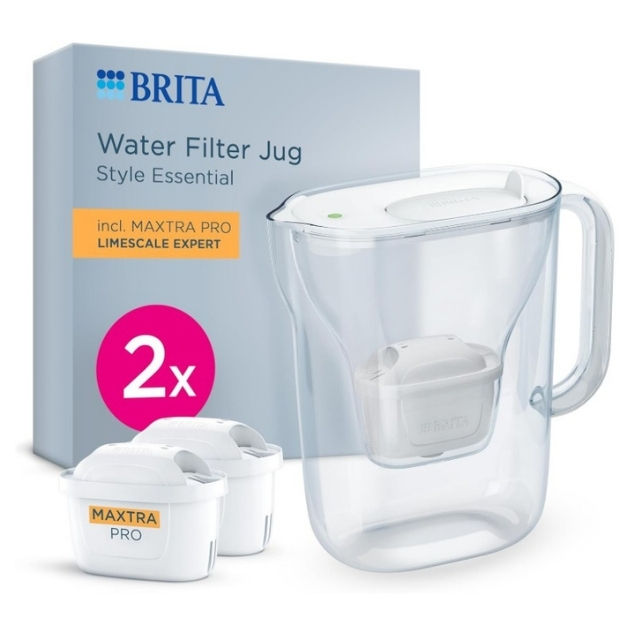
They also use activated carbon to help reduce taste and odour issues, such as chlorine.
In simple terms, the filter helps make the water less likely to leave as much scale behind when it is boiled.
That is why the difference is usually most noticeable in a kettle.
If you use filtered water for hot drinks every day, you may find the kettle stays cleaner for longer and your tea or coffee tastes smoother.
Which Brita filter is best for limescale?
If you have been using a Brita jug for years, you might not realise there is now a cartridge made specifically for hard water.
A lot of us still think of Brita as one basic filter cartridge for better-tasting tap water. But Brita now sells the Maxtra Pro Limescale Expert cartridge, which is designed specifically for hard water areas and kettle scale.
Brita says it offers 50% better limescale protection compared with the Maxtra Pro Pure Performance cartridge. So if you are mainly using your jug to stop the kettle scaling up so quickly, it is worth checking you are using the Limescale Expert version rather than the standard all-rounder.

The Limescale Expert is also the product we picked as our best all-rounder when reviewing water filter jugs for hard water, mainly because it is easy to use, widely available and specifically aimed at kettle limescale.
Does a Brita filter help with hard water?
Yes, a Brita jug can help with hard water — especially if your main issue is kettle scale, tea scum or flat-tasting hot drinks.
Hard water becomes most obvious when it is boiled, because that is when limescale forms and starts building up inside the kettle.
The Brita Maxtra Pro Limescale Expert cartridge is designed to reduce some of that scale-forming hardness before the water is boiled. So it will not remove hard water completely, but it can make a noticeable difference where many people care about it most: in the kettle and in hot drinks.
Does a BRITA filter soften water?
A Brita filter can reduce some of the hardness minerals in drinking water, but it doesn’t technically soften the water.
This is where the wording gets a bit confusing.
Hard water is caused mainly by minerals such as calcium and magnesium. Properly softened water comes from a salt-based ion exchange system fitted to your home’s water supply (a water softener). It removes calcium and magnesium from the water and replaces them with sodium, so the water around your home is genuinely softened.
A Brita jug is different. It also uses ion exchange resin, but only inside a small drinking water cartridge. Its job is to improve drinking water, reduce some scale-forming minerals and help with kettle limescale — not to remove all hardness minerals or create fully softened water.
So if someone asks whether a Brita filter softens hard water, the honest answer is:
It can reduce some hardness minerals in filtered drinking water, but it doesn’t technically soften water.
For kettle use, though, a Brita jug can give you one of the main benefits people want from softened water: less limescale forming when the water is boiled. It will not do this as completely as a proper water softener or reverse osmosis system, but if your goal is simply to reduce kettle scale, the end result can feel similar in day-to-day use.
Does a BRITA filter remove lead?
Brita says its Maxtra Pro cartridges reduce metals such as lead and copper.
That is useful if you want an everyday drinking water filter that does more than just improve the taste.
However, if you know or suspect your home has lead pipes, we would not rely on a jug as your only solution.
Lead in drinking water is more serious than kettle limescale or tea scum, so it is worth speaking to your water supplier and checking whether your pipework needs replacing or whether you need a more specific certified drinking water filter.
For most modern homes, lead probably is not the main reason people buy a Brita jug.
For older homes, it is something to take more seriously.
Does a BRITA filter remove microplastics?
Standard Brita jug cartridges are usually talked about in relation to taste, chlorine, limescale, lead, copper and certain trace impurities.
They are not usually sold first and foremost as specialist microplastic-removal filters.
So we would not buy a standard Brita jug mainly for microplastics unless the exact cartridge or product clearly says it has been tested for that.
Filters like FlowPure and the Maverick Mav 02 are helpful here as they’re both designed slow limescale and reduce plastics.
For a normal Brita jug, we would buy it mainly for:
better-tasting tap water
reduced chlorine taste
less kettle limescale
reduced lead and copper
easier everyday drinking water
cutting down on bottled water
Not as a specialist microplastic filter.
What about BRITA filter taps?
Brita also sells integrated water filter taps, including the Brita mypure P1 3-way tap, which uses a P1000 filter cartridge.
This is a bigger step up from a jug.
Instead of filling a jug and waiting for the water to filter through, you get filtered water straight from the tap. The normal hot and cold water still come through the main mixer, while the filtered water comes through a separate handle.

Brita says the P1000 filter reduces taste and odour issues such as chlorine, heavy metals including lead and copper, and limescale.
It also has a much higher capacity than a jug cartridge. Brita says the P1000 can last from around 400 litres in hard water or high-use homes, up to 1200 litres in softer water or lower-use homes.
So it is more convenient than a jug if you use a lot of filtered water.
But it is also a much bigger purchase. A Brita jug is a low-cost starting point. A Brita filter tap is more of a kitchen upgrade.
BRITA jug vs BRITA filter tap for limescale
A Brita jug is best if you want the simplest and cheapest way to reduce kettle limescale.
A Brita filter tap is better if you want filtered water straight from the tap and do not want to keep refilling a jug.
Both can help with drinking water and kettle scale.
Neither is the same as a whole-house water softener.
So if your main issue is your kettle, either option could help.
Is a BRITA filter enough for hard water?
It depends what you want it to do.
A Brita jug may be enough if you want:
less limescale in the kettle
fewer chalky bits in boiled water
less tea scum
better-tasting tap water
reduced chlorine taste
a cheaper starting point
a simple way to cut down on bottled water
a filter you can use without installation
you do not mind manually filling the jug
It may not be the best choice if you want:
a stronger limescale solution
no manual jug filling
a more convenient set and forget system
the cleanest-tasting drinking water possible
a filter that feels more built into your kitchen
That is where other options are worth comparing.
Other hard water filters worth comparing
A Brita jug is a good starting point for kettle scale and better-tasting drinks, but it is not the only option.
If you like the idea of filtered water without constantly filling a jug, these are the next products we would compare:
FlowPure on-tap filter — a good option if you want filtered water straight from your kitchen tap, without changing your whole setup.
Maverick Mav 02 inline filter — a more hidden under-sink option that filters your cold drinking water without taking up worktop space.
Reverse osmosis system — usually the strongest option for drinking water in hard water areas, especially if you want the biggest reduction in dissolved minerals and kettle scale.
So, for kettle scale and better-tasting drinks, Brita can be enough. For convenience, stronger filtration or a more permanent setup, it is worth looking at the next step up.
So, should you buy a BRITA filter for limescale?
If you want a simple, affordable way to reduce kettle limescale, then yes — a Brita jug with the Maxtra Pro Limescale Expert cartridge is a sensible option.
It will not remove limescale completely.
It will not soften your whole home’s water.
But for everyday drinking water, hot drinks and kettle use, it can make a noticeable difference.
We would especially consider it if you:
live in a hard water area
mainly want better-tasting tea and coffee
are tired of constantly descaling your kettle
want a cheaper option than an under-sink filter
do not want to install anything
want something easy to use every day
If you want the strongest limescale reduction for drinking water, reverse osmosis is more powerful.
If you want to protect your whole house, a water softener is the more complete option.
But if your question is simply “will a Brita filter help with kettle limescale?” — yes, it should help.
Should you buy a Brita filter to reduce limescale?
A Brita filter does not completely remove limescale, but it can reduce the part of hard water that causes scale to form in the kettle.
For most UK homes, that makes it a useful everyday fix for better-tasting drinking water, smoother tea and coffee, and less frequent kettle descaling.
Just be realistic about what it can and cannot do.
A Brita jug can help your kettle.
It will not fix your whole hard water home.

Author bio: Lucinda Smalley is the founder of Hard Water Home, a UK-based consumer site helping households in hard water areas understand the challenges and solutions more easily — and make smarter choices for their health and homes. Based in Poole, she also co-runs an award-winning plumbing company, giving her first-hand insight into how water quality affects everything from appliances to skin and hair. When she’s not writing, she’s happiest at the beach with her family and a good cup of coffee (minus the floaty bits!). More about us ➡


